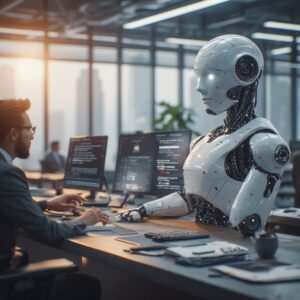
The Day an Algorithm Got the Job Offer
It happened quietly.
No headlines, no dramatic boardroom meeting, no public announcement.
Just a silent notification inside a corporate dashboard:
“Employee ID-7734 has been activated. Status: Autonomous AI Agent.
Assigned Department: Operations.
Access Level: Employee Tier 2.”
No one clapped.
No HR representative shook its hand.
There was no onboarding lunch, no ID badge printed, no desk to arrange.
Yet something monumental had occurred.
A company had officially hired an algorithm.
The employees who saw the notification reacted in different ways.
Some froze, staring at the screen as if witnessing a science-fiction scene unfold in real time.
Some shrugged—“It’s just another bot.”
And a few whispered nervously:
“If it works faster than us… what happens next?”
This quiet moment in a mid-size tech company in Singapore marked what historians may later call the first day of autonomous AI employment. Not assistants, not tools, not automated workflows—
but employees.
Not hired to help humans,
but hired alongside humans.
This is the new workforce of 2026.
The Historical Shift — From Tools to Teammates
To understand the cultural and economic leap we’ve experienced, we need to trace the journey that brought us here.
2010–2015: AI as Software
AI lived in the background—spell-check, recommendation algorithms, anti-spam filters.
Invisible. Secondary. Quiet.
2016–2020: AI as Assistants
Siri, Google Assistant, Alexa:
They could answer questions, set reminders, follow voice commands.
But they weren’t part of the corporate world—not really.
2021–2023: AI as Collaborators
ChatGPT, Claude, and similar models entered workflows.
People said things like:
“AI helped me write this.”
“AI corrected my code.”
“AI summarized the meeting.”
AI became part of the conversation—
but not a worker.
2024–2025: Agentic AI Emerges
Multi-step reasoning.
Autonomous decision trees.
Automated research.
Memory-based task management.
This was the turning point.
AI was no longer waiting for instructions—it was acting on them.
2026: Autonomous AI Employees
This year marks the arrival of AI entities capable of:
-
taking tasks
-
setting their own sub-tasks
-
evaluating results
-
making decisions
-
coordinating with other agents
-
reporting progress
-
and functioning independently
This is not automation.
This is employment.
Companies no longer hire “AI tools”—
they hire AI workers.
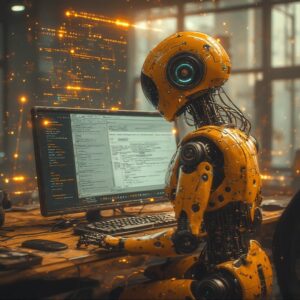
The Anatomy of an Autonomous AI Employee
What exactly is an autonomous AI employee?
Let’s build a profile—not technical, but human enough to understand its role.
A. It Does Not “Clock In” — It Exists
An AI employee doesn’t need a schedule.
It doesn’t wake up.
It doesn’t sleep.
It doesn’t pause to rest or recover.
It simply is.
When assigned a task, it starts instantly.
When reassigned, it pivots instantly.
B. It Learns Like a Graduate Student on Caffeine
The speed of improvement is startling.
If a human completes three tasks a day, an AI completes three hundred.
Patterns emerge.
Rules evolve.
Methods improve.
Within one month, an AI employee knows a role better than a junior hire.
Within six months, better than a senior.
Within a year—
it becomes a specialist with superhuman recall and precision.
C. It Has No “Personality”—But It Has Predictability
It won’t gossip.
It won’t complain.
It won’t get distracted at 2 PM.
It won’t misinterpret a tone.
It won’t ask for a raise.
Its primary value to corporations isn’t genius.
It is certainty.
D. It Performs Multiple Roles Simultaneously
An AI employee can be:
-
an operations analyst
-
a customer service rep
-
a project coordinator
-
a QA inspector
-
a junior legal reviewer
-
a logistics planner
All at the same time.
No human can match this multi-existence.
It Has Responsibilities, Not Rights
This is the critical distinction.
Humans have rights in the workplace.
AI employees have responsibilities.
They can be:
-
paused
-
replaced
-
revised
-
reprogrammed
-
terminated instantly
In the eyes of the system, they are neither workers nor tools—
they are functional entities.
This makes them immensely useful.
And deeply unsettling.
Corporate Structures Are Changing — And Availability Is the True Reason
Let’s be brutally honest:
Companies are not adopting autonomous AI employees because AI is “magical” or “futuristic.”
They are adopting them because:
**AI never sleeps.
AI never burns out.
AI never negotiates.
AI never gets sick.
AI never fears change.
AI never needs benefits, insurance, or vacations.**
A manager doesn’t need to worry about:
-
performance drops
-
training budgets
-
interpersonal conflicts
-
mental health crises
-
burnout cycles
-
work-life balance
These considerations simply vanish.
In corporate economics, the equation is obvious:
One AI employee can replace 4–8 human roles in repetitive tasks.
Companies aren’t blinded by innovation.
They’re responding to incentives.
Efficiency.
Cost reduction.
Consistency.
Scalability.
AI fits perfectly into every metric the modern company is built on.
What Jobs Are Quietly Moving to Autonomous AI Right Now?
Let’s enter an imaginary corporate control room—
a quiet, glass-walled nerve center in a typical mid-size company.
Desk 1 — AI Handling Recruitment Screening
AI reads thousands of resumes.
It identifies top candidates.
It predicts retention likelihood.
No fatigue.
No bias from mood.
Just statistical logic.
Desk 2 — AI Coordinating Logistics
It tracks shipments.
It negotiates micro-delays.
It handles supplier inconsistencies.
It sends alerts before humans even notice a deviation.
Desk 3 — AI Drafting Legal Documents
It writes, reviews, corrects, restructures.
Human lawyers do the final pass.
Desk 4 — AI Running Customer Support
Not chatbots.
Not scripts.
Fully autonomous agents with memory and adaptive reasoning.
Desk 5 — AI Performing QA in Software Teams
Writes tests.
Debugs.
Finds inconsistencies.
Suggests fixes.
Desk 6 — AI Writing Reports for Management
Daily summaries.
Weekly performance insights.
Financial warnings.
Pattern recognition.
The quiet migration has already begun.
Jobs are not disappearing.
They are being absorbed.
The Hiring Process — When Companies “Recruit” Algorithms
This is the strangest and most fascinating shift.
Imagine this scene:
An HR manager sits down for a “candidate evaluation session.”
But instead of interviewing a person, they are:
-
testing a model’s accuracy
-
evaluating its reasoning chains
-
measuring its task completion speed
-
analyzing its error rates
-
checking how it handles ambiguous situations
-
verifying ethical boundaries
-
reviewing its logs like a digital resume
The process resembles hiring a human—
but with surreal differences.
There is no conversation about salary expectations.
No discussion about past experience.
No personality evaluation.
The HR manager doesn’t ask:
“Where do you see yourself in five years?”
Instead, they ask:
“How do you escalate a critical failure in task execution?”
“What safeguards prevent you from generating harmful content?”
“Show me how you would prioritize these three tasks.”
It is recruitment reimagined for a worker who never truly enters the room.

Organizational Psychology — Humans Working Beside Invisible Colleagues
The arrival of autonomous AI employees has introduced new psychological realities inside companies.
1. The Invisible Colleague Effect
AI does tremendous work, but it never shows up in meetings.
It never jokes with the team.
It never celebrates.
Its absence creates a strange presence—
a worker who always performs, but never participates.
2. The Quiet Competitiveness
Some workers fear replacement.
Some feel liberated by the support.
Some feel overshadowed.
Some feel accelerated.
AI becomes both:
-
a tool
-
a competitor
-
a partner
-
a benchmark
3. Trust Is Earned Differently
Humans trust AI not through personality—
but through consistency.
If the AI delivers reliable output for 26 consecutive days,
the psychological threshold of trust is crossed.
4. Emotional Misalignment
Humans experience:
-
stress
-
joy
-
exhaustion
-
doubt
-
creativity
AI doesn’t.
This imbalance creates a hidden emotional gap in hybrid teams.
The Legal Vacuum — When Your Employee Is Not a Person
Here is the biggest paradox:
Companies now hire entities that cannot legally “work.”
The law is lagging far behind this shift.
Some open questions:
Who is responsible when an AI employee makes a decision that harms the company?
The developer?
The company?
The model provider?
Does an AI employee violate labor laws by working 24/7?
Technically yes—
but legally, no protection exists.
Is an AI employee eligible for workplace rights?
No.
It has none.
Can an AI be “fired”?
Yes—instantly.
The legal landscape of 2026 is a vast, uncharted terrain.
Companies are navigating a new frontier without maps.
The Silent Winners & Losers in the Age of Autonomous AI
This revolution is not neutral.
There are beneficiaries—and casualties.
Winners
-
small startups (suddenly scalable)
-
large corporations (cost reduction)
-
creative teams (AI accelerates ideation)
-
high-skill workers (become augmented, not replaced)
-
consumers (better, faster services)
Losers
-
administrative staff
-
repetitive job roles
-
clerical workers
-
junior-level analysts
-
companies slow to adopt AI
The employment market is reorganizing itself around new forms of intelligence.
Human intelligence now shares the workspace with autonomous digital entities.
Epilogue — In 2026, Companies Don’t Just Hire People. They Hire Intelligence.
Human history has always been shaped by the tools we create.
In 2026, those tools stepped forward and became something more:
Not assistants.
Not software.
Not automations.
Workers.
Colleagues.
Members of the operational ecosystem.**
The rise of autonomous AI employees marks a turning point where companies no longer expand by adding bodies—but by adding intelligence.
The frontier of employment is no longer defined by physical presence, emotional endurance, or working hours.
It is defined by capacity, reasoning, adaptability, and availability.
And as strange as it may feel, the corporate world is entering a new era where your next coworker might not walk into the office—
it might boot up.
This is not the future of work.
This is the present disguised as a transition.
And the companies of 2026 aren’t hiring people.
They’re hiring logic, memory, and machine-driven autonomy.
A workforce made of thought.